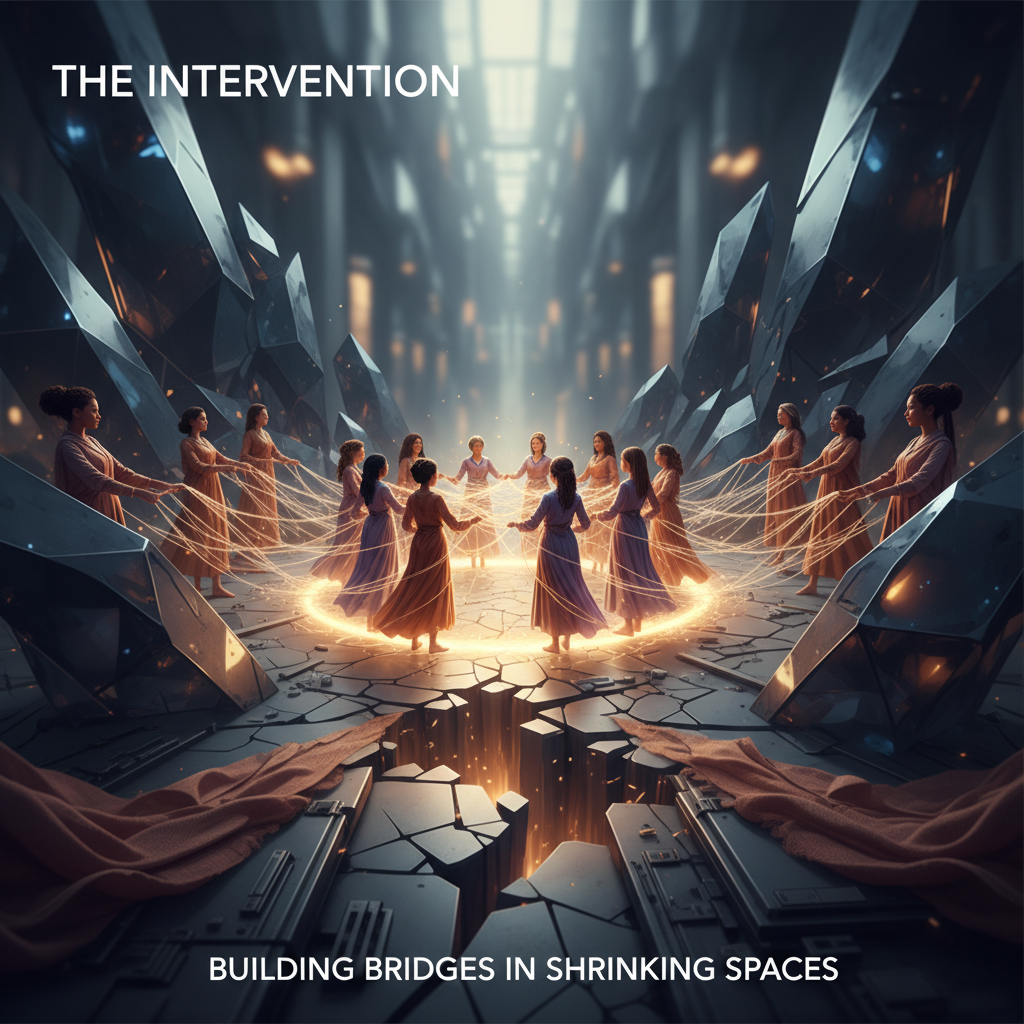
2026 Global Peace Trends: Shrinking Civic Space and Feminist Peacebuilding
Estimated reading time: 7 minutes
Key Takeaways:
- Financial Crisis: G7 nations are projected to cut peacebuilding aid by 28% in 2026, marking the steepest decline since 1960.
- State Aggression: Government entities have increasingly become the primary perpetrators of violence against their own citizens.
- Feminist Necessity: Integrating gender analysis is no longer optional but a strategic requirement to counter the weaponization of hunger and political exclusion.
- Civic Erosion: Systematized content suppression and anti-NGO legislation are dismantling the “enabling environment” for global civil society.
Table of Contents
- The Strategic Contradiction of 2026
- The Convergence of Conflict and Shrinking Space
- The Rise of State Violence and Institutional Failure
- The Funding Collapse: A Crisis by Design
- The Gendered Dimensions of 2026 Conflicts
- Shrinking Civic Space and the War on Information
- Key Influencers and Policy Shifts
- Market and Social Impact: A Sector-Wide Contraction
- Future Outlook: A Permanent Structural Shift
- Practical Takeaways for Advocates and Donors
- Frequently Asked Questions
The global landscape of 2026 is marked by a profound and unsettling paradox. While the need for conflict resolution and humanitarian intervention has reached a historic peak, the institutional and financial support systems designed to facilitate peace are being systematically dismantled. At the heart of this crisis is the emergence of 2026 Global Peace Trends: Shrinking Civic Space and Feminist Peacebuilding, a dual-pronged phenomenon where states are increasingly prioritizing militarization and transactional security over human rights and inclusive governance.
As we navigate this complex year, the international community is witnessing a “strategic contradiction.” On one hand, global violence is escalating, driven by state-led aggression and democratic backsliding. On the other, the resources most capable of preventing future conflicts—namely, peacebuilding funds and civil society organizations—are facing an unprecedented existential threat.
The Convergence of Conflict and Shrinking Space
The intersection of record-high armed conflict, a collapse in democratic norms, and severe funding cuts represents a critical inflection point in global security dynamics. According to the Georgetown Institute for Women, Peace and Security (GIWPS), the intersection of shrinking civic space with gender-responsive conflict analysis has emerged as the central analytical framework for 2026. This framework reveals that women and girls are not only facing disproportionate risks during political transitions but are also being systematically excluded from the very peacebuilding efforts they often lead at the grassroots level.
The Rise of State Violence and Institutional Failure
One of the most concerning aspects of the 2026 landscape is the shift in the nature of violence itself. Research from ACLED (Armed Conflict Location & Event Data Project) indicates that states are increasingly becoming the primary perpetrators of violence against their own civilians.
This trend is most visible in contexts like Russia, Israel, and Myanmar, where state-led military actions are often framed through narrow security interests. What is particularly alarming is the international community’s de-facto acceptance of this violence. As major powers prioritize transactional geopolitics, the previous focus on human-security-centered approaches is being sidelined. When state violence is normalized under the guise of “national security,” the mechanisms for international accountability begin to crumble, leaving civil society vulnerable and exposed.
The Funding Collapse: A Crisis by Design
The financial backbone of global stability is fracturing. The G7 countries—historically the providers of three-quarters of all official development assistance—are projected to reduce their peacebuilding and development contributions by 28% in 2026 compared to 2024. This represents the largest drop in aid since 1960.
This collapse in funding is not merely a result of economic belt-tightening; it is a reallocation of priorities. While peacebuilding budgets are being slashed, global military expenditure rose by an astounding 9.4% in 2024. The results of this shift are already visible on the ground. A February 2025 survey highlighted by Statewatch found that:
- 55% of NGOs have lost significant staff capacity.
- 67% of NGOs have been forced to reduce or entirely shut down essential services.
This capacity vacuum is occurring at the exact moment when conflict prevention is most desperately needed. As Safer World notes, peace advocates are now operating with minimal financial and political support even as violence in their home contexts reaches a breaking point.
The Gendered Dimensions of 2026 Conflicts
In the midst of these structural shifts, the specific vulnerabilities of women and girls are intensifying. The GIWPS 2026 analysis identifies three cross-cutting trends that are defining the experience of women in conflict zones today:
- The Weaponization of Hunger: In regions like Sudan, South Sudan, and Mali, hunger is no longer just a byproduct of war; it is a tactical instrument of conquest. This disproportionately affects women, who are often the last to eat and the first to experience health consequences.
- Repressive Political Transitions: As states undergo turbulent political shifts, women are being systematically excluded from decision-making, serving as cover for the roll-back of rights.
- Compounded Climate Shocks: Climate-induced displacement is hitting women-headed households the hardest, creating a cycle of perpetual physical and economic insecurity.
These trends highlight why “Feminist Peacebuilding” is not just a niche interest—it is a strategic necessity. Without gender-inclusive efforts, the root causes of conflict remain unaddressed, leading to unstable agreements prone to collapse.
Shrinking Civic Space and the War on Information
Civic space—the environment that allows citizens to organize, participate, and communicate—is under a coordinated global assault. From the shutdown of free media to the introduction of anti-NGO legislation, the “enabling environment” for civil society is shrinking.
According to Forus International, content suppression is becoming a systematized tool for governments to control the narrative. In 2026, major elections in Somalia, Uganda, Ethiopia, Morocco, Myanmar, and South Sudan are expected to be flashpoints for repression. Even in Europe, restrictions on legitimate protests indicate that democratic backsliding is a global phenomenon.
Key Influencers and Policy Shifts
Several organizations are leading the charge in monitoring these trends and advocating for a course correction:
- Georgetown Institute for Women, Peace and Security (GIWPS): Their Women, Peace and Security Conflict Tracker is the gold standard for gender-responsive forecasting.
- Parliamentarians for Global Action: They are currently pushing for the establishment of a UN Special Rapporteur on Democracy to address global democratic erosion.
- The United Nations: Despite its critical role, the UN itself is grappling with a $2.4 billion budget shortfall in 2025, leading to significant layoffs.
Market and Social Impact: A Sector-Wide Contraction
The impact of these trends is felt across every sector of global development:
- The NGO Sector: When 67% of NGOs reduce services, the safety net for millions disappears, creating a feedback loop where local grievances turn into regional conflicts.
- Humanitarian Response: Current UN data shows that only 17% of Sustainable Development Goal (SDG) targets are on track.
- Economic Realities: The reallocation of funds creates a “security-development gap.” Short-term security might be purchased through arms, but long-term stability is sacrificed.
Future Outlook: A Permanent Structural Shift
Evidence points to these trends being a permanent structural shift rather than a temporary phase of austerity:
1. Geopolitical Realignment: The move toward “Great Power Competition” means global public goods like peacebuilding are viewed as expendable compared to military readiness.
2. Institutional Memory Loss: Once peacebuilding organizations lose staff and funding, the expertise required to manage complex peace processes vanishes, taking decades to rebuild.
Practical Takeaways for Advocates and Donors
Despite the grim outlook, actionable steps can mitigate the impact of these trends:
- Prioritize Localization: Shift away from international intermediaries and provide direct, flexible funding to local, women-led organizations.
- Integrate Gender Analysis: Policy makers should use gendered risk assessments as early-warning indicators for regional instability.
- Form Cross-Sector Alliances: NGOs should partner with technology companies to combat content suppression.
- Support International Safeguards: Back the Parliamentarians for Global Action initiative for a Special Rapporteur on Democracy.
Conclusion: The 2026 global peace landscape is at a crossroads. When we silence the voices of women and restrict the ability of citizens to organize, we remove the very buffers that prevent political disagreements from turning into bloody conflicts. The global community must recognize that there is no lasting security without human security.
Frequently Asked Questions
What is feminist peacebuilding?
It is a strategic approach that addresses the root causes of conflict by ensuring women’s meaningful participation in peace processes and analyzing how gender dynamics affect security and recovery.
Why is civic space shrinking globally in 2026?
Civic space is shrinking due to a combination of anti-NGO legislation, systematized digital content suppression, and states prioritizing transactional military security over democratic accountability.
How significant are the G7 funding cuts?
The projected 28% reduction in peacebuilding and development aid is the largest drop in international assistance since 1960, signaling a major shift toward militarized budgets.
What is the UN Special Rapporteur on Democracy initiative?
It is a proposed international mechanism advocated by the Parliamentarians for Global Action initiative to monitor and counter the erosion of democratic norms and civic freedoms worldwide.